About The Books
About The Book
The Structure That Built Me
The Structure That Built Me is the human story behind a recognition law that emerged through a lifetime of experience.
Larry J. Patrick takes the reader through the formative experiences, interruptions, disciplines, interventions, professional chapters, crises, and periods of silence that shaped the way he came to see structure. From his early life and the discipline of the Navy to technical education, federal operations, demanding work environments, independent years, and the emergence of the Rhythn Recognition System™, each chapter becomes part of a larger pattern.
The book explores how discipline creates capacity, how pressure reveals structure, and how moments of interruption can become moments of recognition. What initially appears to be a personal journey gradually reveals something larger: the same structural patterns observed in one life can also appear across other systems moving through Time.
This is more than a story of achievement or personal history. It is a record of discovery—the journey of a steward who learned to observe before he had the language to explain what he was seeing.
Book I begins where everything begins: with experience.
The steward comes first.
About The Book
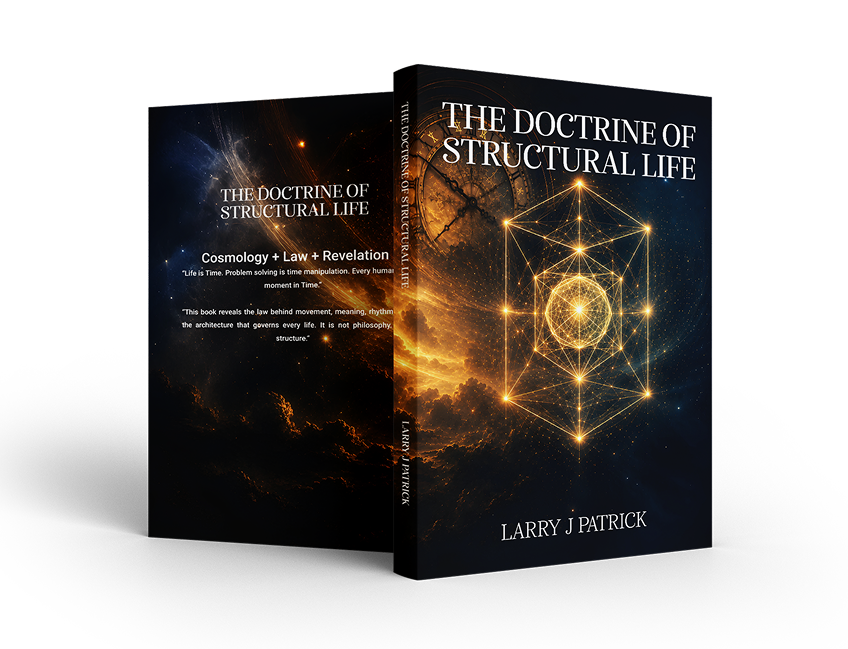
The Doctrine of Structural Life
The Doctrine of Structural Life moves beyond the personal story and establishes the law beneath the experience.
At its foundation are five governing forces: Time, Structure, Rhythm, Recognition, and Stewardship. Together, they form the architecture through which structural life is understood. Time is the medium. Structure is the form. Rhythm is movement. Recognition is awareness. Stewardship is alignment.
The doctrine explores how these forces interact and why alignment between them creates coherence. Structure shapes what can be perceived, endured, and built. Rhythm expresses movement through Time. Recognition is the moment when an underlying pattern becomes visible. Stewardship represents the responsibility to remain aligned with what has been recognized.
The book then expands the scope beyond individual human experience. Its framework is presented as applicable to any structure that moves through Time, including markets, infrastructure, electrical systems, AI load cycles, weather patterns, and crisis environments.
Book II transforms lived experience into doctrine.
The law becomes visible.
About The Book
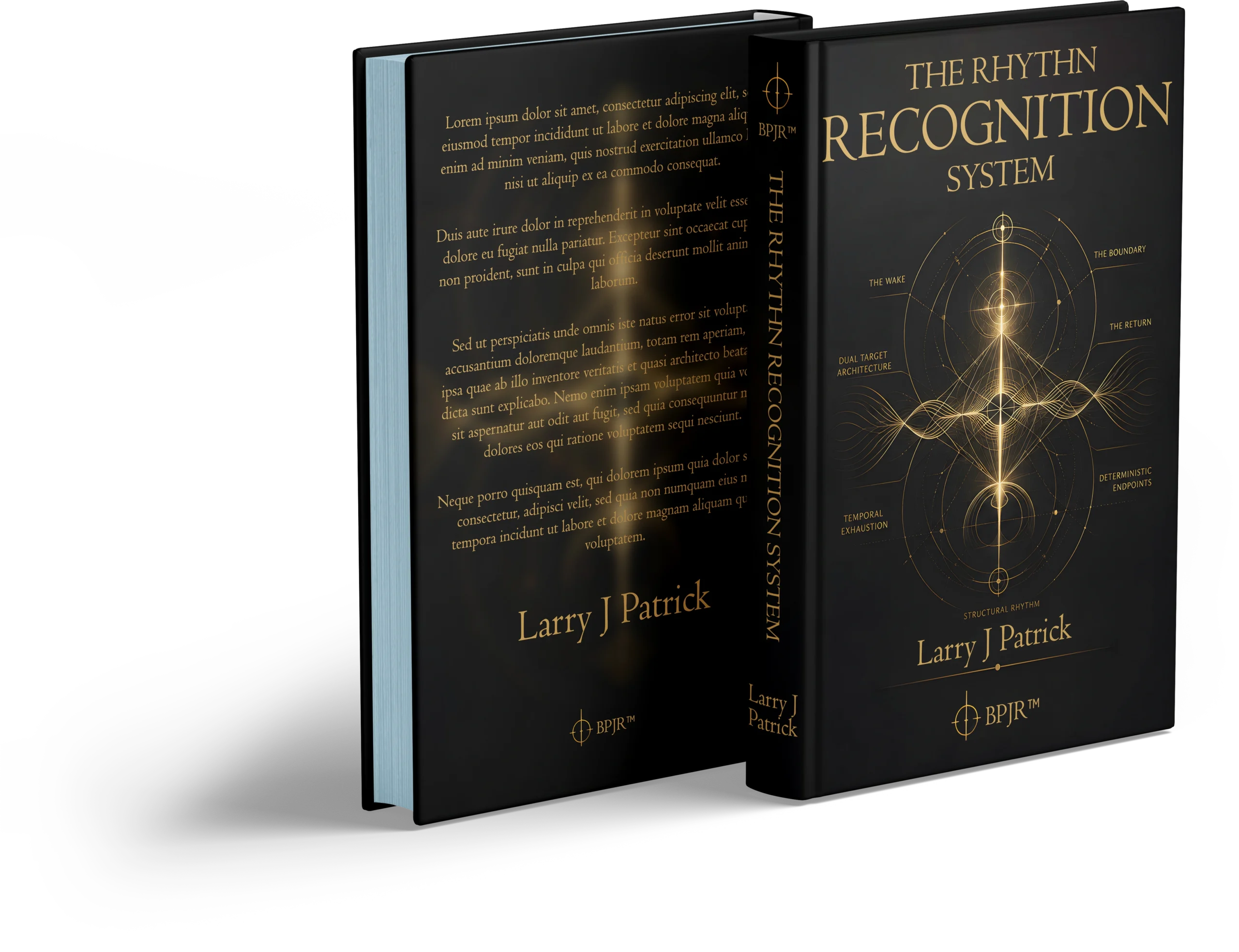
The Rhythn Recognition System™
The Rhythn Recognition System™ brings the trilogy from doctrine into system.
The system begins with observation. Before the terminology, architecture, and mechanics existed, there were signals: directional movement, returns, pauses, acceleration, exhaustion, boundaries, and recurring structural behavior. These observations became the foundation for the system and ultimately led to TPIS™, BPJR™, the dual-target architecture, deterministic cycle structure, and the operational law of recognition.
Book III explores how movement leaves a structural wake and how boundaries, returns, cadence, compression, drift, exhaustion, and endpoints reveal the mechanics of a cycle. The manuscript describes TPIS™ as the engine of immediate rhythm and BPJR™ as the deeper structural rhythm within the system.
The book also expands recognition beyond markets. Its architecture is presented as domain-agnostic, with potential applications across infrastructure, electrical grids, AI load cycles, crisis environments, and human systems.
Book III is where recognition becomes operational architecture.
The system takes form.